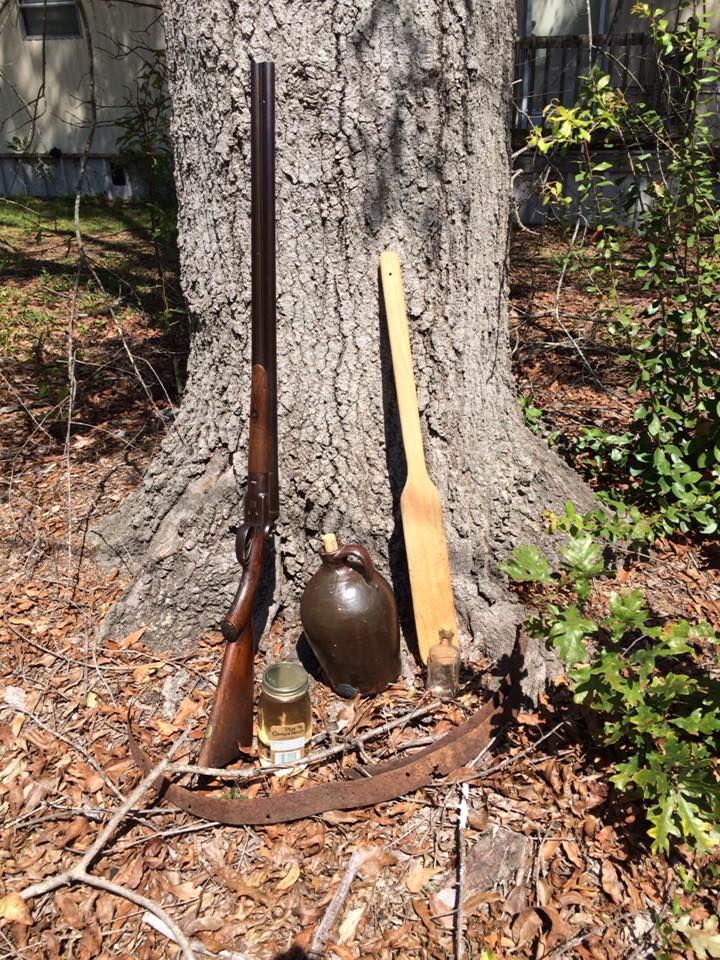
People have been drinking or using some type of alcohol product just about since the beginning of mankind. Why, some old timers say it wasn’t the apple that put Adam and Eve out of the garden, it was the apple brandy.
Water always has been the preferred drink but it didn’t take many generations of our ancestors to come up with recipes for making beer, wine, and other spirits. As folks settled into towns and cities, the water supplies became contaminated and so they drank beer, which had less germs.
When people moved from one country to another they took these time-tested recipes for strong drink with them. Why, it wasn’t long after our country was settled, taverns and distilleries could be found in just about every town and city. Sometimes when a tavern was setup on a well-traveled road or crossroad, a new town would spring up.
Large plantation owners such as our first president had their own whiskey distillers. But the making of whiskey was certainly not limited to the rich, no-sir-re. Why if the truth was known, every creek or spring in our Eastern US once held a whiskey still at one time or the other.
Seems the whiskey business was going fine until right after the Revolutionary War ended. Our government needed funds to help pay for the cost of the war and imposed a federal tax on every gallon of whiskey sold. Government revenuers were sent out all through the towns and country sides to collect these taxes. Some came back tarred and feathered while some never came back at all. Got so bad in the late 1700’s, a Whiskey Rebellion broke out and an all-out war over whiskey taxes broke out in Western Pennsylvania. George Washington himself lead a large number of soldiers to stop the rebellion. The non-collected tax was the reason our government used to send troops against their own countryman. But the real reason was to enable the central government to make new laws and to demonstrate its own strength to carry these the new laws. This sounds a little like today’s government, don’t it?
The main effect of the Whiskey Rebellion felt here in NC was that more Scot-Irish, determined to make whiskey without government interference, moved their operation to the back country of the state.
In 1802, the Whiskey Tax was repealed, but as the years went by others were tacked on yet none ever took root until Abraham Lincoln took office. As part of this package passed by Congress, it created the Internal Revenue Service, which quickly sent out more government revenuers to protect the interest of collecting for our central government. It so happened when the new tax was introduced in NC, the residents just simply refused to pay. In 1876, the government offered a year’s amnesty, and though some distillers took advantage of it, most of them payed it no mind.
For over forty years after that, small whiskey stills continued to run at night all over our state. Thus, the old British word “Moonshiner,” meaning to take on extra work mostly at night, took on a little different meaning.
Before 1920 and Prohibition became the law of the land, most moonshiners took pride in making their brew, but that was about to change. A law to stop the sale of booze only made it worse. The underground whiskey business took off like a modern-day rocket. The sudden attraction of fast profit changed the old-time ways of making whiskey forever. If there was ever a hay-day for illegal whiskey this was it.
During the 20s and 30s, the Great Depression was taking its toll on people. Folks were trying to make a dollar the best and fastest way they could. The old saying, “when times get hard people go to making and drinking more whiskey” is a very true statement.
Being a moonshiner or bootlegger aren’t the same although one can be both. A moonshiner tries to sell his product in bulk form and as fast as he can, while a bootlegger sells whiskey by the drink.
Old time moonshiners could just about tell the proof of their whiskey by shaking it up in a jar and watching the beads (bubbles) form at the top of the jar. One hundred proof whiskey is 50% alcohol. If’en the shine formed large bubbles that disappeared quickly, it indicated that the shine was high in octane (alcohol). If the bubbles were small and were slow to disappear, it was low in alcohol content.
White moonshine is the most common type, although some moonshiners add charcoal to give their shine a rusty, aged look. White Whiskey, rot-gut, mountain dew, or whatever you call it, sometimes has different smells. Some smells gamey or like kerosene, some like a doctor’s office, or some have no smell at all. The taste is raw but some folks only use the back of their hand for a chaser (old time moonshiners say their whiskey ain’t for tasting, it’s for selling). Some shine is as clear as water, while others are riddled with impurities. Recipes vary, but here in NC, it is commonly made with some type of corn product, sugar, water, yeast, and malt. An enzyme in the malt converts the starch in the corn to sugar, and the yeast converts the sugar to alcohol and carbon dioxide. This mixture of ingredients is called the mash. Fifty gallons of mash might include 45 pounds of corn product, 30 pounds of sugar, 1 pound cake of yeast, and 2 pounds of malt and, of course, water. The water is poured over all the ingredients and then the fermentation of the mash begins. Whole corn kernels can be used, but it takes too long to break down, thus production is cut down along with a greater chance of someone finding the still. Cornmeal is too expensive to buy so most shiners use scratch-feed, that is, hog-feed or chicken feed with corn in it. If’en you wanted to make some type of brandy, you just added fruit to the mash.
In hot weather, the mash will work off in three days. The yeast makes it boil and spit. Why, sometimes the barrel of mash sounds like there’s a hive of bees in it while it’s working off. Most shiners will lay a feed bag or burlap sack over the mash barrel and not return to the still until they think the mash is ready to run through the still. All the while, the smell of the mash working off attracts all types of insects and critters who accidentally fall in and make themselves part of the mash. Why, Ol’ Timers never thought nothing about pulling a dead possum out of their mash barrel. In cold weather, the mash can take seven days or more to ferment. Old timers would pack horse manure around the mash barrel to speed up the process. You remember earlier in the story I told you that the whiskey making business had changed some; well, to speed up the fermenting process, people started putting a pillow case or burlap sack of manure into the mash. Why, some low-downs even started putting old car battery’s in the bottom of the mash barrel, all in an effort to speed up the process of fermentation. Meanwhile, as the mash is fermenting, the still is unattended and vulnerable. This is the perfect time for an ABC officer to sneak in and setup on a still, waiting for the owners to return.
Next week we will talk more about the working of a still and the ABC officer’s job of finding the still, arresting the shiners, and destroying the still. Also, more about how they go about catching bootleggers.